Direct-Indirect Body Dynamics Mastery
Keeping the Therapist Healthy, Happy, and Ready for More Bodywork
In this class, you will learn practical tools you can use to maximize the success of your massage technique while minimizing stress on your body. This will allow you to keep doing the work you love for many years to come, while continuing to offer high-quality massages to your clients, and getting the most out of your investment in massage school and beyond.
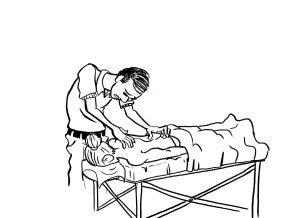 You will practice specific, fun techniques to protect your thumbs, wrists, elbows, shoulders, neck, back, hips, and legs during massage work. You will accomplish this while increasing your body awareness, moving more freely, and minimizing tension, leading to more effective sessions and happier clients.
We will look at the anatomy of specific joints, muscles, and other structures as they relate to massage work, especially with regard to repetitive movement, overuse of certain muscles, and tension. You will learn effective ways to stay in touch with your client’s needs and give an excellent massage, while protecting your body and your livelihood.
Direct-Indirect Body Dynamics helps you become more aware of your own body at work, so that you can move more freely, minimize tension, and maintain your awareness of the client, leading to more effective sessions and happier clients. This also enables you to maintain your own strength and flexibility and continue being able to do bodywork and benefiting clients for as long as you want to.
“I have been doing massage almost 16 years and have developed new onset of wrist and forearm pain.This class gave me the comfort of knowing I can make it better and continue on for many more years.” ~ Dana
Massage for Chronic Conditions
Bodywork for Special-Needs Conditions and Special Populations
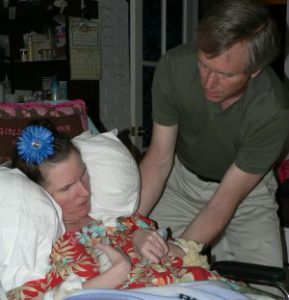 This class teaches you how to use a variety of massage techniques in ‘non-typical’ massage situations and with clients that have special needs. Such environments are becoming more and more common as the general population ages and as medical practitioners learn more about the benefits of massage.
We will look at and practice working with a range of physical conditions and populations, such as clients that are bed-bound or wheelchair-bound, children of varying ages, clients with fibromyalgia, clients with cancer, clients with multiple sclerosis or other autoimmune diseases, clients needing end-of-life care, and clients that have an emotional release during a session.
Several Direct-Indirect and hybrid techniques will be demonstrated and practiced by participants to gain a comfort-level working with clients in these massage situations. Many therapists report that working with such clients is immensely fulfilling and rewarding.
“I liked everything! John instills confidence in students and never makes you feel like you don’t know what you’re doing.” ~ Stephanie
Medical Massage – Chronic Conditions – Ethical Situations – Insurance
DIT – Putting it All Together into a Balanced Bodywork Session
Working on clients with acute or chronic conditions in a clinical setting, such as your office, a hospital, a chiropractic office, or a physical therapy or rehab clinic, requires specialized skills for the massage therapist to be successful. You often work on clients with acute conditions like back pain, headaches, shoulder problems, carpal tunnel syndrome, knee problems, or plantar fascitis, and clients with chronic conditions like fibromyalgia, multiple sclerosis, cancer, or other diagnoses.
 In these situations, you may be most productive working only on that particular problem during that session. Or you may want to do detailed work on that area within the scope of a full-body massage. With either of these scenarios, this class gives you the tools and the framework to be successful at such detailed therapeutic bodywork.
This class will also help you to understand everything you need to know about taking insurance, exactly how to do that, when it works well and when it doesn’t. This can save you a lot of time, money, and frustration!
Clients with acute or chronic conditions often require different massage techniques to achieve similar outcomes, such as loosening tight muscles and fascia, lengthening restricted muscle fibers and intertwined fascial tissue, and working as deep or as light as you need to for each client situation.
The goal is to help clients experience long-lasting relief, better range of motion, and a better quality of life, while taking good care of your own body while you work.
We will look at some of the issues involved with working in clinical situations, such as medical billing, medical codes, certifications, interacting with other health practitioners, and more.
After many years of experience and more than 20,000 bodywork sessions, I have successfully taught thousands of therapists to quickly and easily help clients to feel better, so they can continue doing the job or activities they enjoy doing.
“Excellent experience. John has a natural talent for teaching in a way that is immediately understandable and inspiring.” ~ Quinn